
As digital labor platforms continue to reshape labor markets across Asia, millions of workers increasingly rely on platform-mediated work as a primary source of income. While platform work offers flexibility and low barriers to entry, it often operates outside traditional labour protections, leaving workers exposed to economic insecurity, occupational risks, and limited access to social protection.
Against this backdrop, the International Labour Organization’s (ILO) 114th International Labour Conference (ILC), held in Geneva from 1-12 June 2026, marked a significant milestone with discussions on a proposed Convention on Decent Work in the Platform Economy. As governments, workers’ organizations, employers, and researchers debate the future of labor standards in the digital age, it is increasingly important that the realities of platform workers in Asia inform these global discussions.
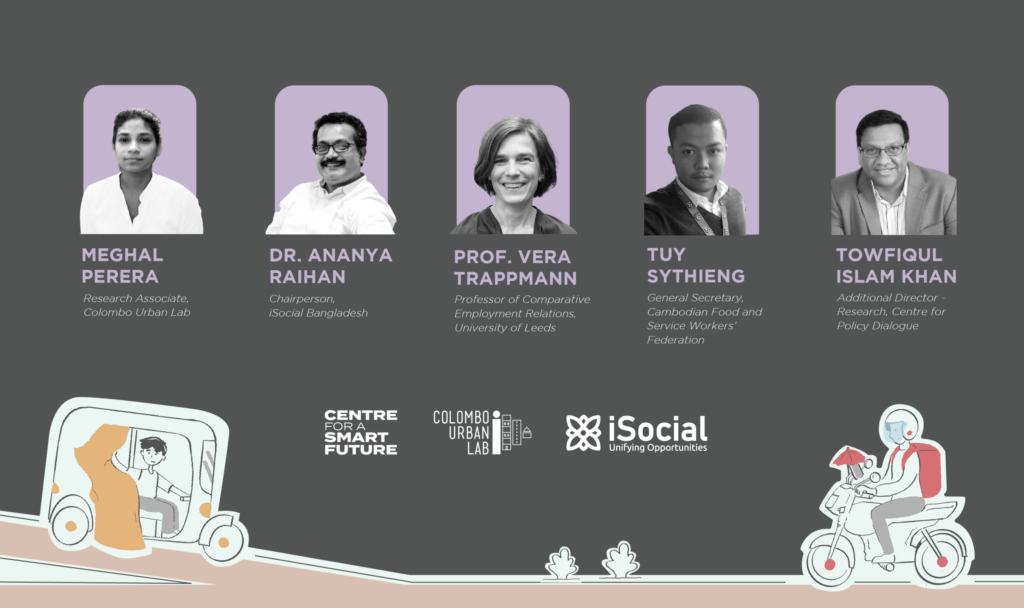
To contribute Asian perspectives to this conversation, the Centre for a Smart Future (CSF), in collaboration with iSocial, organized a webinar, “Freedom and Fairness in Platform-Mediated Gig Work: Perspectives from Asia” on 10 June, 2026.
The webinar brought together a distinguished panel of researchers, labor advocates, and policy experts, including Dr. Ananya Raihan, Chairperson of iSocial (Bangladesh); Mr. Towfiqul Islam Khan, Additional Director of Research at the Centre for Policy Dialogue (CPD), Bangladesh; Ms. Meghal Perera, Research Associate at Colombo Urban Lab, Sri Lanka; Mr. Sythieng Tuy, General Secretary of the Cambodian Food and Service Workers’ Federation (CFSWF), Cambodia; and Professor Vera Trappmann, Professor of Comparative Employment Relations at the University of Leeds, United Kingdom.
Drawing on experiences from Bangladesh, Sri Lanka, Cambodia, and beyond, the discussion examined how platform economies are transforming work, the challenges workers face in accessing rights and protections, and the policy reforms needed to ensure that digital innovation is accompanied by decent work.
Platform Work and Emerging Vulnerabilities Across Asia
Opening the discussion from the Sri Lankan perspective, Ms. Perera highlighted how platform workers, particularly motorbike riders engaged in ride-sharing and delivery services, are increasingly exposed to unsafe working conditions due to extreme heat, heavy rainfall, and other climate-related risks. While adverse weather often increases demand for delivery services, workers frequently bear the associated health and safety risks without adequate protection or compensation.
Ms. Perera also highlighted the gendered dimensions of platform work. Women remain significantly underrepresented in ride-sharing and delivery services, reflecting broader barriers related to safety concerns, social norms, and limited institutional support. The discussion underscored the need for worker-friendly urban infrastructure and social protection measures that do not transfer the costs of adaptation onto workers themselves.
The Legal Vacuum Facing Platform Workers
Speaking from the Bangladesh perspective, Dr. Raihan argued that one of the defining features of platform-mediated work is the gap between economic dependence and legal recognition. Despite providing essential services and generating significant economic value, platform workers remain largely excluded from labor laws and the social protection systems.
Dr. Raihan noted that workers often face long working hours, income insecurity, unilateral changes to platform policies, and limited opportunities to negotiate terms and conditions. He argued that platform business models frequently classify workers as independent contractors while retaining substantial control over their work through algorithms, incentive structures, and performance monitoring systems.
The discussion also highlighted concerns regarding data governance and value distribution. Workers continuously generate valuable data through their interactions with platforms, yet they have little visibility into how this information is used and receive limited benefits from the value it creates.
Economic Insecurity and Unequal Value Distribution
Building on these concerns, Dr. Raihan emphasized that platform economies often shift operational risks and costs from companies to workers. While platforms, consumers, and investors benefit from digital intermediation, workers frequently absorb the costs associated with vehicles, fuel, maintenance, equipment, and income fluctuations.
Similarly, Mr. Khan highlighted that Bangladesh’s platform workforce is predominantly composed of young and moderately educated workers seeking employment opportunities in a challenging labor market. However, many workers face occupational risks including traffic accidents, theft, and unstable earnings, while existing labor protection frameworks provide limited support.
Mr. Khan stressed that platform work has evolved beyond a supplementary source of income and has become a primary livelihood strategy for many workers. This shift, he argued, requires policymakers to formally recognize platform work and develop responsive policy frameworks that reflect its growing significance within the national labor markets.
Organizing Workers in a Changing Labor Landscape
Drawing on the Cambodian experience, Mr. Tuy highlighted the challenges faced by food delivery and service workers amid economic uncertainty, technological change, and weak labor protections. He noted that workers frequently encounter debt burdens, income insecurity, limited social protection, and restricted opportunities for collective bargaining.
Women workers face additional challenges, including inadequate maternity protections and limited workplace support. Despite these constraints, trade unions and worker organizations continue to expand their outreach and organizing efforts among food delivery workers and other platform-based workers.
The discussion illustrated how workers across Asia are increasingly turning to informal associations, worker councils, digital networks, and collective action to strengthen representation and advocate for improved working conditions.
Platform Labor Protest and Global Trends
Drawing on evidence from the Leeds Index of Platform Labor Protest, Prof. Trappmann provided a global perspective on how platform workers have mobilized in response to deteriorating working conditions. The database tracks worker protests across multiple countries and documents actions ranging from strikes and demonstrations to legal challenges and collective bargaining initiatives.
Prof. Trappmann noted that concerns over pay and earnings remain the most common drivers of worker protests globally. She also highlighted the growing importance of health and safety concerns, particularly in the context of climate change, which may become an increasingly significant source of worker mobilization in the years ahead.
Her analysis also showed that in many parts of Asia, worker organizing often occurs outside traditional trade union structures, reflecting both legal barriers and the evolving nature of platform-mediated work.
Rethinking Social Protection for Platform Workers
A central theme emerging from the discussion was the need to modernize social protection systems to reflect changing forms of work.
Both Mr. Khan and Dr. Raihan emphasized that platform workers remain inadequately covered by existing labor and social protection frameworks. The absence of portable benefits, pension schemes, employment injury protection, and accessible insurance mechanisms leaves many workers vulnerable to economic shocks and workplace risks.
Speakers highlighted the importance of collaborative approaches involving governments, platforms, workers, and service providers to develop sustainable solutions that can extend protections to platform workers while preserving flexibility where appropriate.
Towards Fairer Platform Economies
The webinar underscored that platform work is no longer a marginal phenomenon. It has become an increasingly important source of employment and income generation across Asia, requiring stronger legal recognition, more equitable business practices, and expanded social protection systems.
While the experiences of workers in Bangladesh, Sri Lanka, Cambodia, and other countries differ in important ways, the discussion revealed several common challenges, including legal exclusion, income insecurity, occupational risks, gender-based barriers, and limited worker voice. Addressing these challenges will require coordinated action from governments, platforms, workers’ organizations, researchers, and civil society actors.
As global discussions on decent work in the platform economy continue to evolve, ensuring that Asian experiences and perspectives are reflected in international standards will be essential for building platform economies that are both innovative and fair.
View the full webinar here: https://www.youtube.com/watch?v=6bn2LIPtlsE
Acknowledgement: This webinar summary was originally prepared by the Centre for a Smart Future (CSF) team. The version published on the iSocial website has been reviewed and edited by the iSocial team.